Showing posts with label LEED. Show all posts

Friday, January 28, 2011

LEED Design: ConAgra's Food Production

Not to long ago I went on a lengthy rant about how awesome Walgreens is being by rolling out a fleet of LEED certified pharmacies, which you can find here. The main point of my article was that the public benefits from Walgreens' initiative because they are indirectly educated by being surrounded with green initiatives.

Another form of indirect consumer education can be seen with ConAgra Foods. They are the proud owners of the first LEED Platinum certified frozen food manufacturing plant. This is impressive because manufacturing plants are resource intensive, but this proves that companies can still be efficient in their traditional practices while embracing more efficient and modern technologies.

It is a safe bet that ConAgra Foods will advertise their green practices on any products that come out of this plant, which will attract new customers while also turning consumers on to greener practices. This could place new pressure on ConAgra's competitors that could end up leading to more food manufacturers pursuing LEED certification.

This is the direction that I have expected the world to start head, but it is nice to actually observe it happen before my eyes. It may seem like a small deal right now, but down the road we could look back and point to this as the beginning of something big.


And guess who told you about it?


Friday, January 14, 2011

Walgreens: Leading In Corporate LEED Establishments

You see the term "LEED Certified" thrown around a lot. More times than not, you will see this term describing a new office building being constructed out of cleaner materials and utilizing more efficient means of energy consumption.

This is great and I hope the practice only continues to grow, but when it comes down to it, it goes unnoticed. For the most part, the only people noticing these LEED certified changes are the people working within the office building, and even then they don't really see the results until they look at their energy bill.

The transparency of these changes is a mixed blessing:
  • It is good because people have this idea that more efficiency means sacrificing aesthetic value and functionality, so when they don't notice a difference between LEED certified and traditional buildings it proves that there are no sacrifices being mad.
  • It is bad because when people don't notice the changes taking place, it makes it more difficult to transfer these clean practices to people's homes.
This is where Walgreens is doing such a nice job "educating" the general public. Walgreens has been rolling out LEED certified stores in Illinois and is planning to expand their sustainable fleet to other states in the near future. Here is what their store in Chicago has to offer:
The Logan Square Walgreens, nestled in an urban area right off the Kennedy Expressway, features a “green roof” with plants growing on it. The roof also has a white coating to help reduce heating and cooling costs. The store will save nearly 34,000 gallons of water a year with efficient water fixtures. During construction, 85 percent of waste was diverted from landfills. The site was a brownfield which was cleaned up and redeveloped for this project. Coolers, freezers and exterior signs all use LED lights, reducing energy use by 50 percent over fluorescent lighting. The store will save enough electricity to power more than five homes a year. In addition, there is special parking for hybrid vehicles, bike racks and nearby public transportation.
This is great for many environmental reasons, and I don't think I have to hold your hand and explain exactly what those are. What truly is great about this is that hundreds of people walk through this Walgreens every day, and each one is getting a hands on experience of what efficiency can look like.

The store also showcases many different informational signs telling the shoppers about all the different aspects of this green store. This is definitely something that a LEED certified business park can't offer to the general public.

Finally, this just makes good business sense. The most glaring benefits are the water and electricity savings that the store is enjoying:
  • 34,000 gallons of water saved.
  • Cutting enough electricity from their bill to power more than 5 homes a year.
These are real savings that Walgreens can take to the bank.

Also, did you catch the part about the LED lighting?
          You think that their informational signs will praise their lighting?
                    Want to bet that Walgreens will start selling more LED bulbs this year?

I hope more companies follow Walgreens lead and start pursuing these sustainable business practices more aggressively.

Monday, November 15, 2010

A Rare Opportunity For Sustainability In New Orleans

It is easy to see that I am passionate about all things clean energy related.  However, it isn't as easy to see how these things are applied in real life because for the most part the application of clean energy and sustainable practices is scattered randomly across the nation on a small scale.

In New Orleans it is a different story.  Yes, Hurricane Katrina was a terrible event that is still indescribable on so many levels...but if there was a silver lining to this tragedy, it is the opportunity to rebuild the city in a cleaner, more sustainable fashion that can serve as an example for the rest of the nation.

Recently I was down in New Orleans observing the impact that the oil industry has had on the area (particularly with the Deepwater Horizon spill).  Aside from seeing a spider eat an entire frog right before my eyes*, I also visited the Lower Ninth Ward which was the hardest hit area in New Orleans during Katrina.

*Awesome.
The interesting part about the Lower Ninth is that the opportunity to rebuild a whole section of a city is rare at best because it is typically impossible to justify the costs of tearing down an entire neighborhood in order to rebuild.  Tragically, the majority of the Ninth was destroyed, but moving forward it can now be rebuilt in a more sustainable fashion.

This is exactly what some organizations such as Global Green USA is doing right now.  Global Green is building new homes in the Lower Ninth which are LEED Platinum certified which is the gold (platinum) standard of energy efficient building.

I had the pleasure of walking through one of these homes and they really are quite impressive.  Solar panels on the roof, incredibly efficient appliances, energy monitoring software, responsible water usage in the bathrooms, and much more - these homes are amazing.

Also, there is no feeling that you are sacrificing comfort which I feel a lot of people assume when they hear about sustainable living.  The rooms are spacious and the materials are nice.  If you were to walk into this house without knowing that it was LEED certified, I would be willing to bet that most people wouldn't recognize a difference between these homes and other newly built homes in other areas.

It is wonderful to see that there are people out there that recognize the opportunity for sustainability in New Orleans and I hope that this becomes more and more common in other cities across the nation as time goes on.

Thursday, November 11, 2010

Does Sustainability Mean Sacrificing Aesthetic Value?

One of the shallower complaints about alternative energy, most notably wind energy, is that the structures are not aesthetically pleasing.  These complaints hit a fever pitch during the debates about placing a wind farm off the coast of Cape Cod in the Nantucket Sound when old rich people said that it would ruin the scenery.

The fact is that these wind turbines would have been barely visible from the shoreline, amplified by the fact that most of the people fighting Cape Wind are over 60 with worsening eyesight, really rubs me the wrong way...but that is neither here nor there.

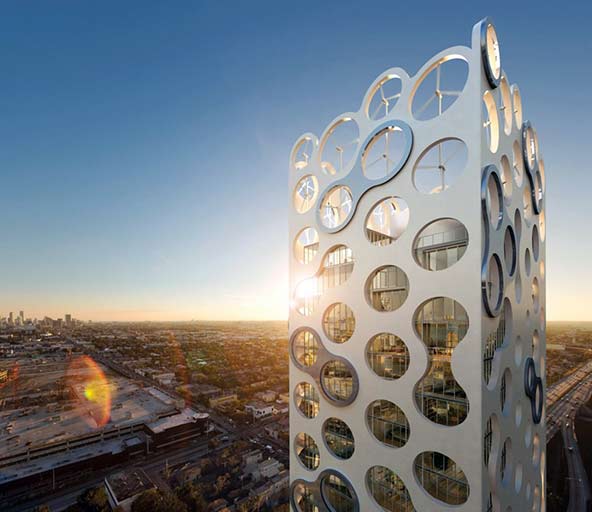
Today I stumbled across some pictures of some gorgeous sustainable architecture that can be found in Miami.  I'll let the pictures speak for themselves, but these are great examples of the unlimited possibilities of green architecture and why we need to keep on challenging ourselves to be more efficient without thinking that we need to sacrifice style.

Estimated completion in 2011.
(http://www.oppenoffice.com/)

View from inside.
(http://www.oppenoffice.com/)

For more information and pictures, go to GreenMuze or Oppenheim.