Showing posts with label wind. Show all posts

Monday, January 10, 2011

Cape Wind: It Is About Time

Well look at that.  A week after announcing that I am switching over to a three-day posting regimen, I am finally posting something on time!

Today I woke up to an article about Cape Wind being cleared for construction, and my first reaction was similar to the last modern Star Wars movie:

"Finally, it is over."

Man, this character sucked.
The Cape Wind battle has been a long and relatively boring ordeal since its beginning in 2009. Never has there been a better demonstration of few rich old people holding up progress for their own aesthetic interests.  The main complaint was that the wind farm would destroy the scenic quality of the Nantucket Sound, which you can see in an artists rendition below:


You are probably thinking "EWWWWWW!," and who could blame you.  Those minuscule wind turbines are totally going to ruin the view out of your multi-million dollar beach house, but sacrifices MUST be made in the name of progress.

In all seriousness, this project has taken an unnecessarily long time to get to the construction phase, and hopefully once it is finally completed, it will set a precedent for other coastal areas to allow these farms to be constructed.  They don't damage the property value of these coastal residences at all, and may even increase the value over time with a cheaper source of energy.

Wednesday, January 5, 2011

Wind Turbines Eating Entire Bird Populations?

During my last semester at school, I got to write a fairly enjoyable paper on the dangers that wind turbines pose to bat populations.  To make a long story short, bats are getting killed by wind turbines as their navigation systems are "jammed" by the noise created by the rotating blades.

A "similar" event is happening with wind turbines killing birds as they migrate. I place similar in quotations because birds do not use sonar to navigate, and to be completely honest these birds aren't presenting as challenging of a problem as the bats.
A spokeswoman for the American Bird Conservancy rants:
Golden eagles, whooping cranes and greater sage-grouse are likely to be among the birds most affected by poorly planned and sited wind projects.
Because these birds are migrating, a simple solution to the bird kills is to shut off the turbines during migration season.  This isn't that difficult to do because migration patterns are relatively predictable and fall along pretty standard paths.  Obviously it isn't perfectly mechanical and there will be variability in how birds actually do migrate, but shutting off certain turbines makes more sense than just abandoning construction of clean energy entirely in these areas.

Wednesday, December 22, 2010

Combining Infrastructures: Cellular Networks & Wind Turbines

I was driving today streaming Pandora Radio through my iPhone and I began to think about how this would not have been possible over 5 years ago due to the lack of high-speed data networks spread across the area.

For the most part high-speed networks are plentiful around big cities such as Chicago, but they are still lacking in the remote parts of the nation. A good example of this is when I was driving from Chicago to Ohio during Thanksgiving.

For the most part, Pandora was able to stream throughout Northern Indiana along 1-65, but it started to get choppy when I passed Indianapolis all the way along 1-70 to Columbus.  The choppiness could be attributed to the patchy high-speed coverage along the highway, and this is where I believe a logical solution presents itself.

Because data networks tend to suffer in remote areas and wind turbines tend to produce the most energy in the same remote areas, I think this is a great opportunity for cellular companies to partner with wind turbine manufacturers and construct hybrid wind turbine-cellular towers.


There are a few examples of these being built, but nothing on a large scale.  More and more people are relying on these high-speed data networks for their everyday lives, which means that these networks will need to be bulked up all across the nation.  This will increase their demand for energy, and I believe that this is a great opportunity for them to invest in clean energy.

By constructing wind turbines that double as cell towers they are essentially increasing their bottom line by not having to buy energy from utilities and instead being able to sell the excess energy back to consumers.

Like any of these energy solutions, this would require a larger upfront investment, but considering that America's information network is an ongoing project, I don't see a reason why they wouldn't attack both of these long-term projects at the same time.


When most business decisions come down to resource allocation, building one tower instead of two saves money and makes sense.

Tuesday, November 30, 2010

Traffic Hurt By "Wind Gazers"

For those of you that actually read my blog over the holiday weekend, you will know that I drove through Indiana on Friday as well as Sunday. Anyone that has driven through Indiana knows that the entire state is relatively boring in terms of scenery.

For as far as the eye can see you are overwhelmed by cornfields and nothingness (with the exception of Indianapolis which lasts for all of 10 minutes). However, the wind farms on 1-65 have broken up this sprawling boringness of the flat land with towering beacons of clean energy.

It really is impressive to see hundreds of these wind turbines moving at once, especially when you consider that each one of these things costs upwards of $2 million. Another cool aspect of this particular wind farm is its incredibly close proximity to the highway that the video below demonstrates.


However, there may be one small draw back for these wind farms in Indiana. I didn’t notice this on Friday because the roads were so empty, but on Sunday when everyone was heading back home from their holiday weekend the traffic was noticeably slower once we entered the wind farm.

Up until these farms traffic was chugging along at 70-75 mph, but once we entered the wind turbine fields, traffic dropped to around 60 mph. This doesn’t sound like a huge difference, but it was noticeably slower.

This is probably because many people are just not used to sprawling fields of towering pinwheels, and traffic probably wasn’t helped by people like me that were taking pictures and videos with their cell phones. Once we passed through the farms traffic jumped back up to its regular pace, but it was very interesting to witness these changes in speeds.

I'm just as guilty of taking pictures while driving.
I imagine (and hope) that as time goes by and these wind turbine fields become more of a standard sight people won’t be as distracted and almost mystified by these turbines – I just wonder how long that will take.

Monday, November 29, 2010

Sustainable Architecture: Taiwan's Green Building

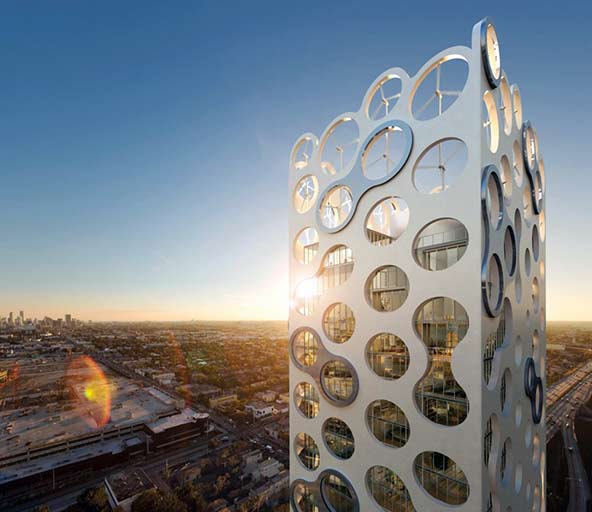
The other week I talked about an energy efficient building down in Miami and how it is defying the view that ecologically friendly building practices are not as pleasing to look at as other ‘traditional’ forms of architecture.

I believe that post speaks for itself and supports my point, but today I wanted to highlight a building that is going to be in constructed in Taiwan because it is truly groundbreaking in design.


This building is set to be constructed in 2012 and will have a minimal ecological footprint as it is designed to collect and purify its own water from rainfall and will be heated through geothermal power.  It will also generate electricity through solar and wind powers.

Most notably, the design looks like something out of a video game (probably because it was inspired by them according to Romanian architect Stefan Dorin). As you can see from the above picture, the building looks similar to a tree and its leaf-like observation pods will move up and down the ‘trunk’ of the structure.

This is a great example of how green architecture can be really cool while also stimulating the local economy through increased tourism.

I’m fully aware of how our markets aren’t exactly friendly towards new construction projects in America at the moment, but it would be great to see some cities eventually follow Taiwan’s lead and invest more in these cleaner and edgier buildings.

Saturday, November 27, 2010

Google Is The Best

Yesterday I drove through Indiana which has fields of wind turbines visible from I-65, which truly is a cool site.  It is hard to understand why people think that these turbines are so ugly, especially after you drive through Gary, Indiana which is infinitely less aesthetically pleasing.

This caused me to think of probably the understatement of the century:  Google is great.


Clearly, on the internet front, Google reigns king.  However, it looks like Google is planning on being a large contributor to our nation's energy system in the future.

Recently, Google has decided to be a major investor in a 350 mile cable on the east coast of the United States which will support up to 6,000 MW of off-shore wind energy.


The price tag of the entire project will be $5 billion and will help power around 1.9 million homes with clean energy.  Google has already invested tens of millions of dollars into this project and will continue to do so as the project is developed.

Google clearly recognizes that there is a lot of money to be made in this arena which informs their large initial investment, so one can hope that other large companies follow in their footsteps.

Thursday, November 11, 2010

Does Sustainability Mean Sacrificing Aesthetic Value?

One of the shallower complaints about alternative energy, most notably wind energy, is that the structures are not aesthetically pleasing.  These complaints hit a fever pitch during the debates about placing a wind farm off the coast of Cape Cod in the Nantucket Sound when old rich people said that it would ruin the scenery.

The fact is that these wind turbines would have been barely visible from the shoreline, amplified by the fact that most of the people fighting Cape Wind are over 60 with worsening eyesight, really rubs me the wrong way...but that is neither here nor there.

Today I stumbled across some pictures of some gorgeous sustainable architecture that can be found in Miami.  I'll let the pictures speak for themselves, but these are great examples of the unlimited possibilities of green architecture and why we need to keep on challenging ourselves to be more efficient without thinking that we need to sacrifice style.

Estimated completion in 2011.
(http://www.oppenoffice.com/)

View from inside.
(http://www.oppenoffice.com/)

For more information and pictures, go to GreenMuze or Oppenheim.

Monday, November 8, 2010

Tidal Energy Is Making Important Strides

It is quickly becoming clear that big battles are rapidly approaching on the political horizon, and I am going to do my best to cover these events as thoroughly as I possibly can. However, I won’t be getting to those things until tomorrow because I still need time to wrap my head around the numerous issues that are popping up.

Right now I’m going to talk about a notable event in the world of alternative energy. While the alternative energy marketplace is dominated by news about wind and solar developments, today marks the day that a shallow-water tidal energy system in the UK has been successfully tested and proven.

*Yes. I made that comparison just so I could post this picture from one of the best South Park episodes ever.

While the media views tidal energy as the red headed stepchild* of the alternative energy community, it is important that this technology is still being researched and developed. This is because at the end of the day, no matter how well wind and solar are performing, they are subject to their natural limitations:

  • Wind
    • Produces the most energy at night
    • Windiest in remote areas leading to transmission issues
    • Subject to pressure systems
  • Solar
    • Only producing energy during the day
    • Subject to cloud cover
    • Not as effective in the further Northern and Southern Hemispheres

The point of listing these limitations isn’t to suggest that these technologies are inefficient in addressing our energy needs. Instead, it is to show that it will take a collaborative effort between multiple technologies in order to make clean energy work. This is why the further development of tidal energy is wonderful and necessary because it can help lessen the burden on wind and solar technologies.

Obviously tidal energy is only really useful where there are tides (“Thanks, Professor!”), but when coasts contain some of the most densely populated cities and ports; tidal energy makes sense. By combining tidal energy with offshore wind farms, clean energy stands to make a large dent in the energy consumption of these areas.